
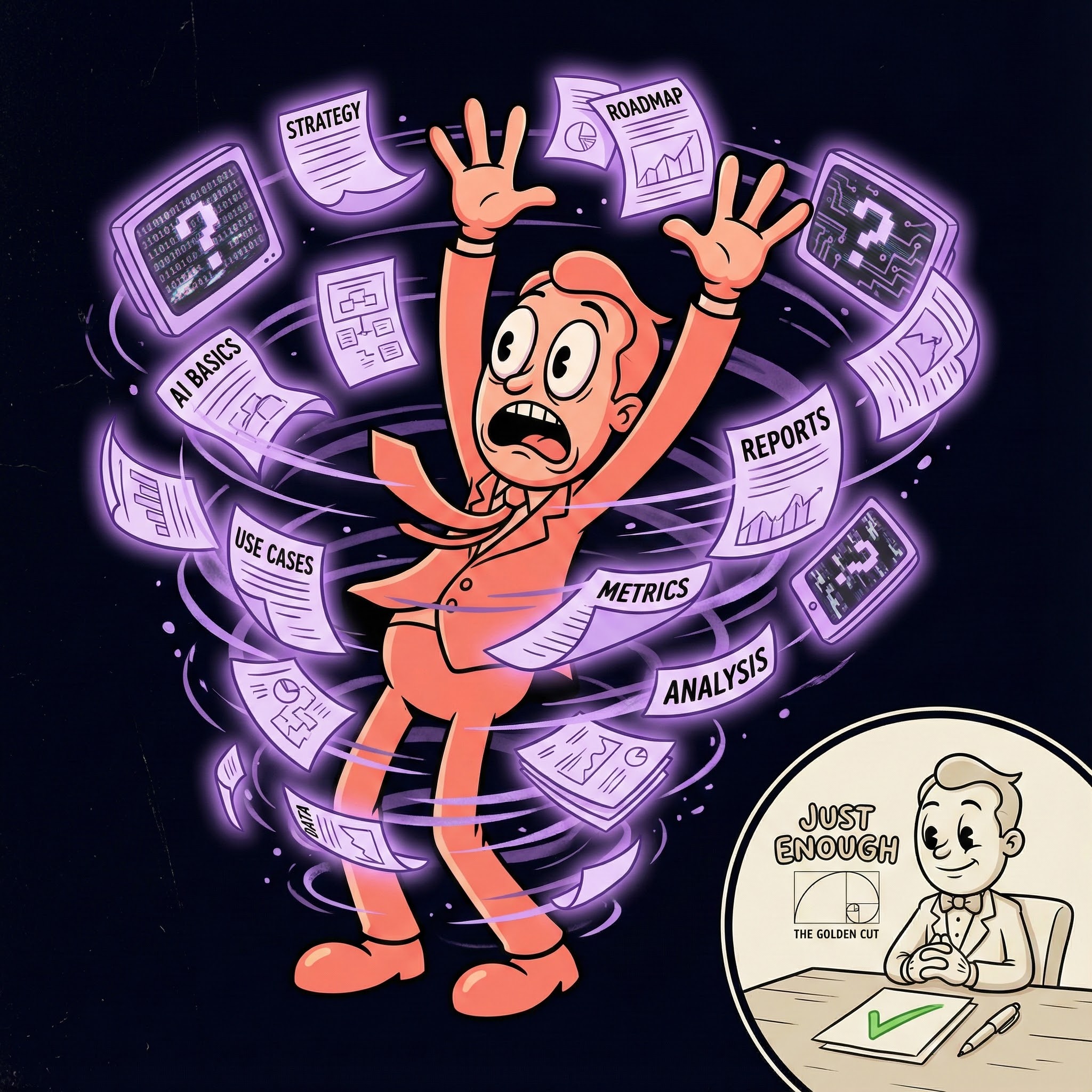
You hired consultants. Read whitepapers. Attended webinars. Built a task force.
Six months later, you're no closer to actually moving.
You're not alone. 74% of companies struggle to achieve and scale value from AI. And in 2025, 42% abandoned most of their AI initiatives—up from just 17% the year before.
The problem isn't lack of effort.
It's that you're trying to understand everything before you do anything.
Let me explain.
The Expertise Trap
Most executives think they (or someone in the company) need to become AI experts before they can make good decisions. So they go deep. Really deep. Either they themselves or a designated person.
They hire consultants who teach them about transformer architectures. They learn the difference between supervised and unsupervised learning. They study use cases from seventeen different industries.
And then they get lost.
Because here's the thing: You don't need expertise. You need just enough to decide competently.
There's a massive difference.
What "Just Enough" Actually Means
You need to know four things. Not four hundred.
1. The basics of what AI actually is
Not the technical details. The decision-making fundamentals:
- What's automation? (Rules-based, repeatable tasks)
- What's AI? (Pattern recognition, prediction)
- What's agentic AI? (AI that can take actions based on goals)
- What's an AI agent? (Autonomous systems that make decisions and act)
That's it. One to two hours of clear explanation beats three months of technical deep-dives.
2. What AI can actually do for your business
Not theoretical possibilities. Real capabilities:
- Where can it save time without sacrificing quality?
- Where can it surface insights you're currently missing?
- Where can it handle volume you can't scale manually?
You don't need to understand how it works. You need to know what it does.
3. Where to start without betting the company
Not a comprehensive roadmap. A first experiment:
- One workflow that's painful today
- One metric you can measure
- One week to see if it actually helps
Speed beats perfection. Always.
4. How to tell if it's working
Not ROI projections for 2027. Clear success criteria:
- Did the thing we hoped would improve actually improve?
- By how much?
- What do we do next based on what we learned?
That's just enough. Everything else is noise. For now.
The Data Overwhelm Problem
Here's the uncomfortable truth: 72% of business leaders admit that the sheer volume of data prevents them from making ANY decision.
Not just AI decisions. Any decision.
And what do consultants do when executives are drowning in information? They add more information.
More frameworks. More case studies. More technical specifications. More vendor comparisons.
It's well-intentioned. But it's paralyzing.
Because while you're learning, your competitors are experimenting. While you're planning the perfect strategy, they're running messy pilots and learning what actually works.
The Confidence Gap
Here's where it gets dangerous.
90% of C-suite executives say they're confident making AI decisions.
Only 8% actually possess substantial knowledge of AI technologies.
That's an 82-point gap between confidence and competence.
You know what that gap is filled with? Consultants selling certainty. Vendors selling sophistication. And executives making decisions based on buzzwords instead of understanding.
The ones who succeed aren't the ones who know the most. They're the ones who know just enough to start, and learn everything else by doing.
What Success Actually Looks Like
You don't need to understand transformer architectures to deploy a customer service chatbot.
You don't need a PhD in machine learning to automate your reporting workflows.
You don't need to master prompt engineering to use AI for market research.
You need to know:
- What problem you're solving
- How you'll measure success
- What you'll do if it works (or doesn't)
That's competent decision-making. And it's enough.
The executives who are winning at AI adoption aren't the ones with the most knowledge. They're the ones with the clearest thinking.
They ask better questions:
- "What's the smallest experiment we can run this week?"
- "How will we know if this is actually helping?"
- "What will we do with the time we save?"
Not:
- "What's the optimal architecture for our use case?"
- "How does this compare to seventeen other solutions?"
- "What if we're missing something?"
The Golden Cut
There is a simple, fast way to do AI right.
It's not about going wide and deep before you start. It's about going narrow and shallow, learning fast, and building from there.
Step 1: Know where you stand
Before anything else, benchmark yourself. Not against theoretical best practices. Against real companies doing real work.
Where are you actually strong? Where are you actually weak? What's the gap between where you are and where you need to be?
The AI Maturity Index and mundaine have teamed up. Take the assessment for executives. Fifteen minutes. Free. Anonymous. Benchmarked against thousands of executives worldwide. Available in English and German.
Step 2: Pick one painful workflow
Not the most strategic. Not the highest ROI. The most painful.
The thing your team complains about. The bottleneck that slows everything down. The task that makes people groan.
That's your starting point.
Step 3: Run a 7-day experiment
Not a 6-month pilot. Seven days.
- What do you believe will improve?
- How will you measure it?
- What does success look like?
One week. Real work. Real measurement.
Step 4: Decide and move
Success? Scale it.
Failure? Pivot or kill it.
Unclear? Run it one more week with better metrics.
But decide. And move.
The Real Cost of Waiting
Every day you spend "getting ready" for AI is a day you're not learning what actually works in your business.
Your competitors aren't waiting. The 26% who aren't struggling to scale AI value? They started before they were ready. They learned by doing. They built competence through action, not study.
You don't need to know everything.
You need to know just enough to start. And you need to start now.
Before you hire another high-profile consultant. Before you read another whitepaper. Before you build another task force.
Benchmark where you stand. Pick one experiment. Run it for seven days. Learn. Decide. Move.
That's the golden cut.
Simple. Clear. Applicable.
Ready to stop learning and start doing?
Take the AI Maturity Index assessment. See where you actually stand. Then run your first experiment this week.
Sources
- BCG Press Release (Oct 2024) - 74% of companies struggle to scale AI value
- BayTech Consulting - 42% abandoned AI initiatives in 2025
- Fast Company/MIT Sloan - 90% confident, 8% knowledgeable
- Oracle/Fortune - 72% paralyzed by data volume