
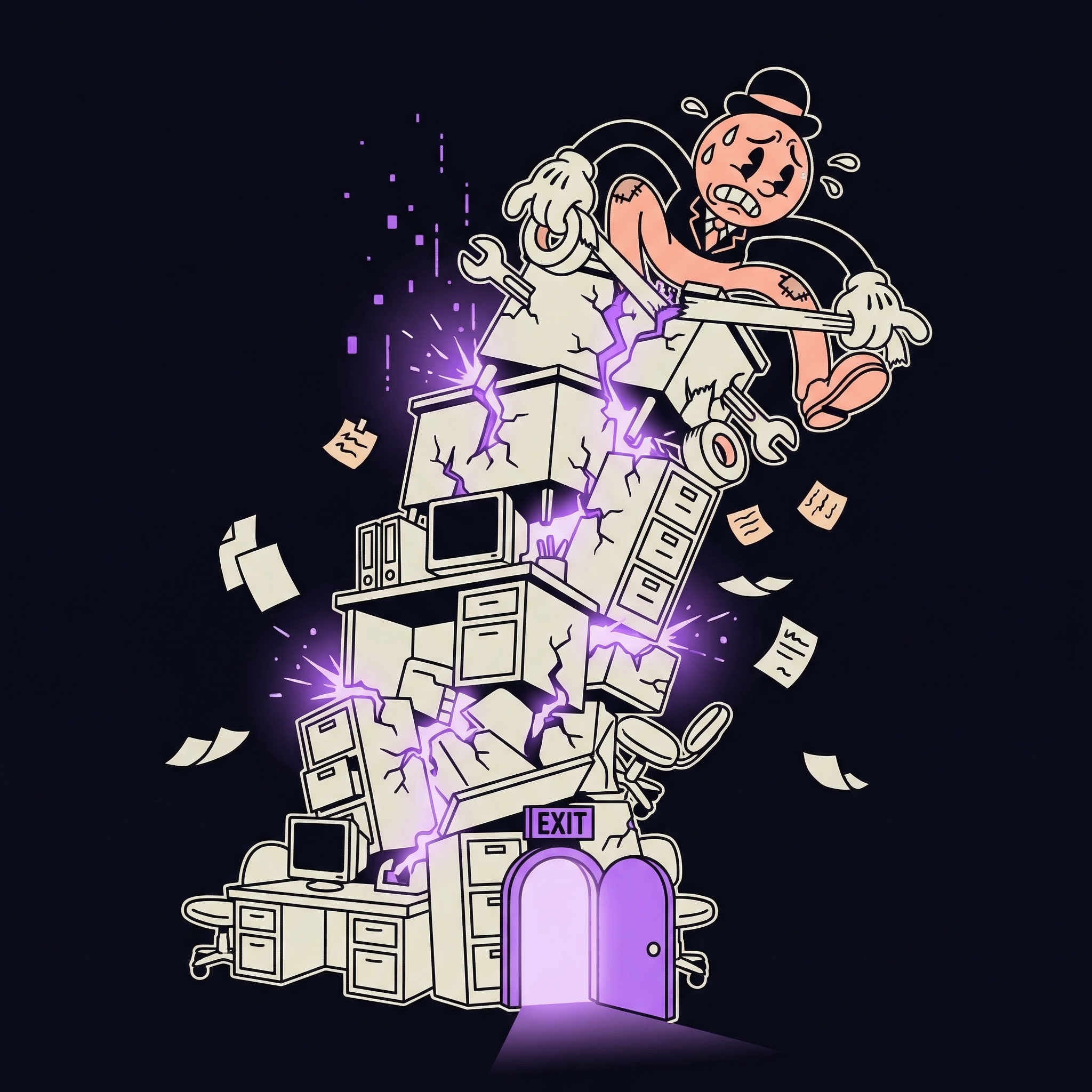
Your CTO is spending 40% of their time on work that has nothing to do with your product. And you're wondering why you're not shipping faster.
I've been watching a pattern repeat itself across every scaling company I work with.
The team grows from 10 to 30 to 50 people. Revenue goes up. Complexity goes up faster. And somewhere along the way, your most technical leader stops building product and starts managing chaos. HR tickets. Process gaps. Operational bottlenecks that nobody else can fix because nobody else understands how the systems connect.
The problem isn't your people. It's the system they're trapped in.
The instinct is always the same: hire more people. But there's a math problem hiding inside that instinct, and most leaders don't see it until it's too late.
The Hiring Paradox
Every new hire adds capability. But every new hire also adds coordination overhead.
More Slack channels. More alignment meetings. More context that needs sharing. Research on scaling organizations shows that employment costs reach 1.4 times the base salary when you factor in benefits, equipment, onboarding, and management time. And that's before the invisible tax: the hours your existing team spends bringing the new person up to speed instead of building product.
At 10 people, this works. Everyone knows everything. Communication is ambient. You overhear what you need to know.
At 30, it breaks. Tribal knowledge doesn't transfer. Processes that were "just how we do things" become bottlenecks. Your CTO, the person who should be thinking about architecture and product direction, is now spending their days triaging operational fires.
At 50, it's a full-blown crisis disguised as growth.
The CHF 15k vs. CHF 180k Question
When I sit with CEOs who feel this pain, the conversation often goes like this: "We need to hire a senior AI engineer to automate some of this."
Fair instinct. But let's do the math.
A senior AI engineer in Switzerland costs roughly CHF 160,000 per year in base salary. Factor in the 13th month, social contributions, equipment, and the 3-6 months before they ship anything meaningful, and you're looking at a CHF 180,000+ commitment before you've seen a single result.
Or: you can spend CHF 15,000 on a Build Week. Five days. One operational bottleneck. Working software by Friday.
That's not a pitch. That's what happened.
The CEO Who Just Wanted to Fix One Thing
A CEO came to me recently. His team was drowning in operational data work. Reports that took hours. Manual processes that pulled people away from what they were hired to do. He didn't want a transformation. He wanted to fix one thing.
We spent Monday understanding the problem. By Wednesday, we had a working prototype. By Friday, the workflow that used to consume hours was running in minutes.
His CTO was skeptical at first. Rightly so. He'd seen enough consultants come in with big promises and leave with big invoices. What changed his mind wasn't the pitch. It was that we started by respecting his environment. We didn't rip anything out. We didn't demand new infrastructure. We built on top of what they already had.
The result: one automated workflow, one team with hours back in their week, and a CTO who could finally think about product again.
The Real Adoption Gap
Most companies get stuck right after a win like that.
OpenAI's State of Enterprise AI report found something striking: frontier workers (the top 5% of AI users in an organization) send 6 times more messages than the median employee. For coding tasks, that gap jumps to 17x. Same company. Same tools. Same access.
Access isn't the bottleneck. Behavior is.
I use an analogy that tends to land: giving your team access to AI tools is like buying a gym membership for a couch potato. The gym is there. The machines work fine. But without changing the daily habits, without someone showing you what to do on day one, the membership just collects dust.
42% of companies abandoned most of their AI initiatives in 2025, up from 17% the year before, according to S&P Global. Not because the technology failed. Because the adoption model failed. Companies bought the gym membership and expected results.
What Actually Works
The companies I've seen break through this pattern share three things:
1. They start with one workflow, not a strategy deck.
Pick the operational bottleneck that's most visibly eating time. Automate that. Let the result speak for itself. The strategy conversation is easier after people have seen what's possible.
2. They fix the system before they add headcount.
Hiring into a broken system just scales the chaos. When your CTO is debugging operational problems, the answer isn't "hire someone to help the CTO." The answer is to remove the operational problem.
3. They treat adoption as a mindset shift, not a technology rollout.
The 6x gap in OpenAI's data isn't about skill. It's about mental operating system. The top 5% didn't get better training. They developed the habit of reaching for AI first. That shift doesn't happen through a company-wide email announcing new tools. It happens when one person on one team solves one real problem and tells their colleague about it.
What This Means for You
If your CTO is spending more time on operational fires than product work, the constraint isn't talent. It's architecture.
If you're thinking about hiring a senior AI engineer as your first move, pause. Run the math. A single Build Week can validate whether AI solves your bottleneck before you commit to a six-figure annual hire. Think of it as the rational first step before the headcount commitment.
And if your team already has AI tools but isn't really using them, the problem isn't the tools. It's the habit. Start with one workflow. One team. One win.
The companies that scale well in the next few years won't be the ones that hired the most AI engineers. They'll be the ones that fixed the systems that were wasting their people, then built the habits that made AI part of how they work.
Your CTO shouldn't be debugging operational bottlenecks. They should be building product.
Fix the system. The people will follow.
Damian helps scaling companies stop wasting their best people on work that doesn't matter. His Build Week takes one operational bottleneck from problem to working software in five days. Learn more at mundaine.ai