
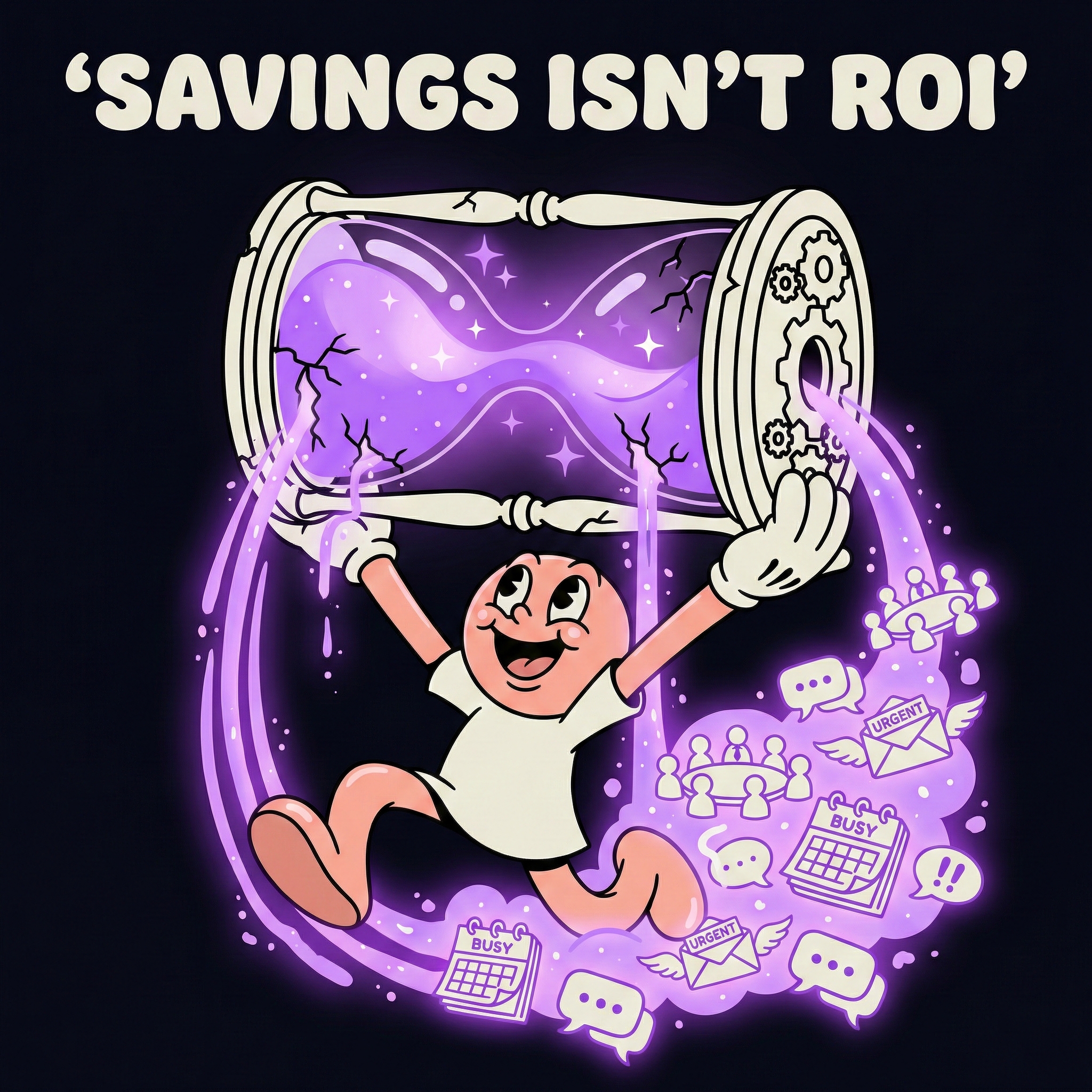
Your AI consultant is making you dumber.
Not on purpose. They're probably quite smart. They've helped you save 40 hours a month. Your team generates reports in minutes instead of hours. The efficiency gains look great on the quarterly deck.
But here's what they never asked you: "What will you do with those 40 hours?"
And that question is worth more than every hour you saved.
The Celebration Trap
I see this pattern constantly. Company implements AI. Time savings appear. Everyone celebrates. Then those saved hours quietly fill with more meetings, more email, more busywork. Six months later, nobody can point to what actually changed.
The efficiency gains evaporated. They got absorbed back into the noise.
This is the celebration trap. You measure inputs (time saved) instead of outputs (value created). You congratulate yourself for running faster without asking where you're running to.
BCG surveyed over 1,000 executives across 59 countries. 74% struggle to achieve and scale value from AI. ServiceNow's AI Maturity Index found that fewer than 1% of organizations even crack the midway point on their maturity scale. The average score dropped 9 points year-over-year.
Companies aren't failing because they can't save time. They're failing because they don't know what to do with it.
The Question Nobody Asks
Here's the uncomfortable truth about most AI consulting engagements.
They focus on the wrong half of the equation.
The hard part isn't finding where AI can save time. That's the easy part. Any decent consultant can audit your processes and find automation opportunities. The hard part is the question that comes next:
"What will we do with the freed capacity?"
This is the leverage question. And almost nobody asks it.
I sat with a client last year who'd implemented AI across their customer service operations. They were saving 40 hours per month. I asked what they were doing with those hours.
Silence.
They hadn't thought about it. The hours just... got absorbed. More tickets. More meetings. More of the same work that used to fill the day.
That's not ROI. That's just redistribution.
Savings vs. Leverage
Let me make this concrete.
Saving 10 hours a week on report generation is not valuable by itself. It's only valuable if you convert those hours into something that moves the business forward.
The ROI of AI isn't in the savings. It's in what the savings enable.
Four conversion paths:
Growth: Those 10 hours become more client outreach. More sales conversations. More pipeline. That's revenue leverage.
Quality: Those 10 hours become deeper work on complex cases. Better outcomes. Fewer errors. That's excellence leverage.
Expansion: Those 10 hours become time to launch something new. A product. A service. A market. That's opportunity leverage.
Retention: Those 10 hours mean your best people stop working nights and weekends. They stay. That's human leverage.
Each path converts the same saved time into completely different outcomes. But you have to choose one. Deliberately. Before you start.
Why This Gets Missed
There's a reason consultants don't push the leverage question.
It's hard.
Identifying efficiency gains is technical work. You audit processes, find bottlenecks, implement automation. It's measurable. It's defensible. It fits neatly into a project scope.
The leverage question is strategic work. It requires understanding the company's direction, its constraints, its competitive position. It means asking executives uncomfortable questions about priorities. It means connecting AI initiatives to business outcomes that might be two or three steps removed from the automation itself.
Most consultants stay in their lane. They deliver the efficiency gains, declare victory, and move on.
Which is why 74% of companies struggle to see value.
The Maturity Illusion
Here's what the data tells us.
90% of C-suite executives believe their people are ready to use AI effectively. Only 70% of employees agree. And when you dig deeper, only 8% of executives have sufficient AI literacy to actually guide these initiatives.
Organizations spend three times more of their AI budget on technology than on people.
This creates a dangerous illusion. Leadership thinks they're further along than they are. They see the tools deployed. They see the time savings. They assume value is being created.
But value doesn't come from deployment. Value comes from leverage.
The companies winning with AI aren't the ones saving the most time. They're the ones converting saved time into strategic advantage.
Connecting to Corporate Strategy
The leverage question forces alignment.
When you ask "What will we do with the freed capacity?" you're really asking: "What does this company need most right now?"
Is it growth? Then saved hours become customer acquisition.
Is it profitability? Then saved hours become efficiency that drops to the bottom line.
Is it innovation? Then saved hours become R&D bandwidth.
Is it talent retention? Then saved hours become better work-life balance.
The answer depends on your strategy. And if your AI initiatives aren't connected to your strategy, you're just automating in circles.
This is why the first conversation shouldn't be about AI capabilities. It should be about business priorities. What does the company need? Where is the competitive pressure? What would change the game?
Then work backward to AI.
Before You Start Your Next AI Initiative
Ask the leverage question first. Not after. Before.
Before you scope the project. Before you hire the consultant. Before you deploy the tool.
"If this works, what will we do with the freed capacity?"
Write down the answer. Make it specific. "We will use 15 reclaimed hours per week to increase outbound sales calls by 30%." Or: "We will reallocate two FTEs to the product development team." Or: "We will reduce average weekly hours from 50 to 45 without cutting output."
If you can't answer clearly, you're not ready to start.
The time savings will evaporate. The efficiency gains will get absorbed. And six months from now, you'll be in that 74% wondering why AI didn't deliver the value everyone promised.
The Real Test
Here's how you know if your AI adoption is working.
Not: "How many hours did we save?"
But: "What did we build with those hours?"
The winners aren't the ones who saved the most time. They're the ones who converted it into something that matters.
Speed without direction is just motion. Efficiency without leverage is just busyness with better tools.
Your AI consultant gave you hours back. The question is whether you're investing those hours or wasting them.
That's on you. Not them.
Ready to connect AI initiatives to actual business outcomes?
Let's talk about a Sprint week or Executive Sparring session where we don't just find efficiency gains. We build the leverage strategy that converts them.
Simple. Clear. Applicable.
Sources
- 1. BCG (October 2024). "AI Adoption in 2024: 74% of Companies Struggle to Achieve and Scale Value." Survey of 1,000+ executives across 59 countries. BCG Press Release
- 2. ServiceNow & Oxford Economics (2025). "Enterprise AI Maturity Index 2025." Survey of 4,500 executives. Fewer than 1% scored over 50 on the 100-point maturity scale. ServiceNow
- 3. Accenture (2025). Study cited in Fortune showing 90% of C-suite believe workers are AI-ready while only 70% of employees agree. Fortune
- 4. MIT Sloan Management Review (2024). Research finding only 8% of board-level executives have substantial AI literacy.
- 5. Faros AI (2025). "The AI Productivity Paradox." 75%+ of developers use AI coding tools, but most organizations see no measurable performance gains. Faros AI