
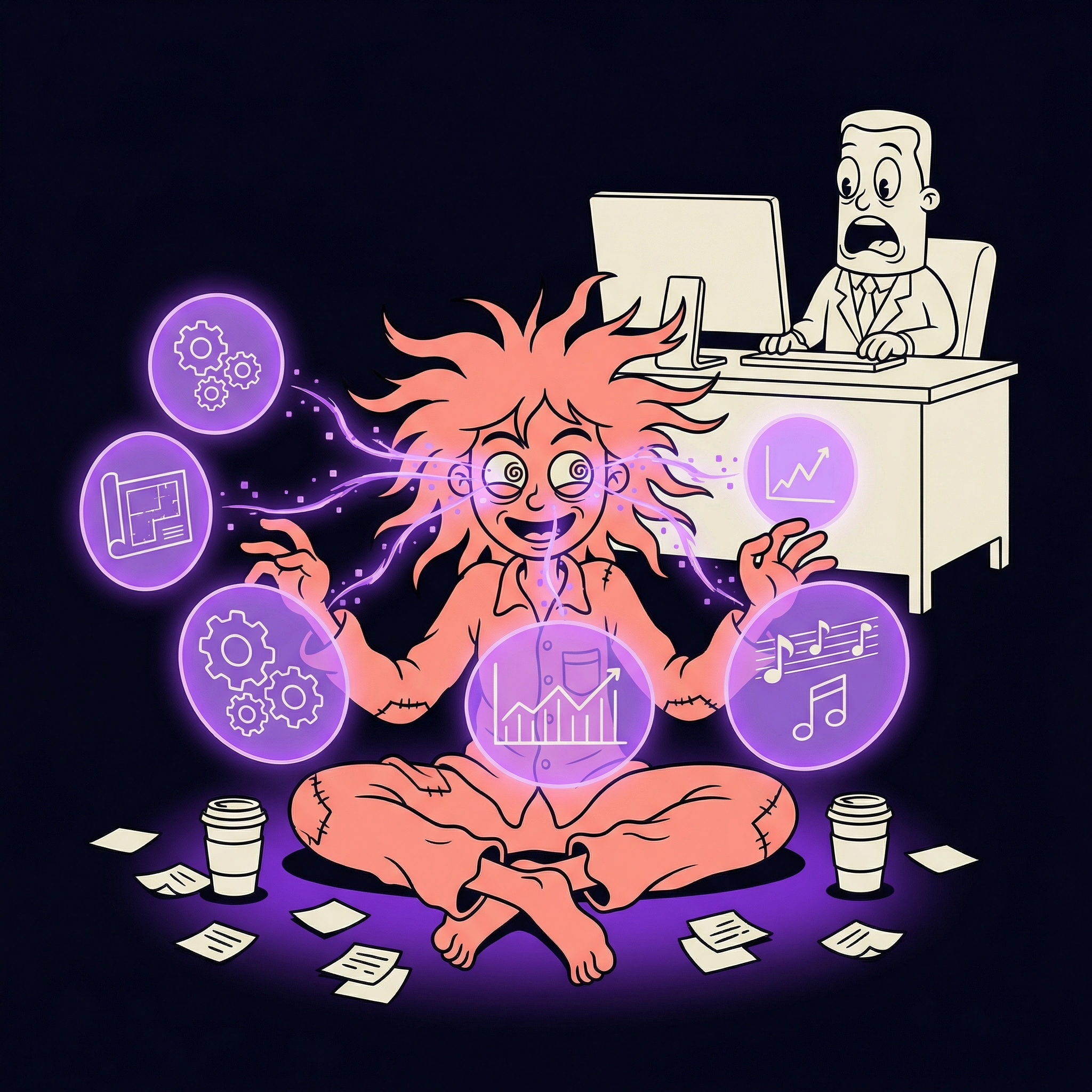
Your best AI adoption champions aren't who you think they are.
They showed up looking like they rolled out of bed. They can't sit through a two-hour meeting without checking their phone. They jump between five tasks before finishing one. And your managers wrote them off before lunch.
Meanwhile, those same people are running six AI sessions in parallel while your senior team is still crafting their first prompt.
Let me explain.
The Talent You're Trying to Fix
A Google/Harris Poll survey found that 93% of Gen Z knowledge workers already use two or more AI tools every week. Not experimenting. Not dabbling. Using them as core work tools. ChatGPT, image generators, transcription tools, code assistants. The full stack.
Compare that to the average adoption rate across all generations, and the gap is staggering.
But most companies aren't celebrating this. They're trying to manage it. "Follow the process." "Use the approved tools." "Stop skipping steps."
The corporate instinct is conformity. And conformity is the most expensive tax you'll pay in the AI era.
The Cognitive Patterns Nobody Valued Until Now
This goes deeper than age. There's a second group getting overlooked, and this one is personal.
I run Claude Code across multiple terminals at the same time. I jump from one to the next to the next. In the time I would have completed one thing in an hour, I complete four to six. Different projects. Different contexts. Constant switching.
For most of my career, that kind of brain was a problem. "Focus on one thing." "Stop jumping around." "You need to concentrate."
But rapid context-switching isn't a flaw when you're orchestrating parallel AI sessions. It's throughput.
ADHD minds have been forced to context-switch their entire lives. Not by choice. By wiring. And now, the AI era is handing them an environment where that wiring becomes a competitive advantage.
Autistic pattern recognition and deep focus? That's exactly what you need for prompt engineering and system design. The ability to hold complex structures in your head, spot inconsistencies, and iterate on precise instructions. These are the skills AI work rewards most.
What used to be a "handicap" in the old work model is becoming a genuine advantage. Not because ADHD or autism changed. Because the work changed.
The Numbers Tell the Story
An EY global study across 17 organizations found that 68% of neurodivergent employees reported AI tools reduced their work anxieties. 71% said AI gave them hope about their careers.
But the stat that should make every leader pay attention: during a six-week innovation sprint where neurodivergent team members used AI tools, they generated 60 to 80 process improvement suggestions. Not from consultants. Not from a strategy team. From the people most organizations are still trying to make "fit in."
A Gallup survey of 2,500 young adults found 74% had used AI chatbots in the past month alone. They're not waiting for permission. They're not waiting for training programs. They're already building the muscle your company needs.
The Conformity Tax
Every company forcing Gen Z into legacy work styles and neurodivergent minds into neurotypical patterns is paying a hidden cost. I call it the Conformity Tax.
It looks like this:
→ The intern who "can't focus" would have been your best multi-agent orchestrator
→ The Gen Z hire who "doesn't follow process" sees automation opportunities veterans miss
→ The developer with ADHD who "jumps between tasks" naturally runs parallel workstreams that 10x output
You're not managing performance problems. You're suppressing exactly the cognitive patterns AI rewards.
And you're paying for it with slower adoption, missed opportunities, and your best potential champions leaving for companies that see them clearly.
What This Means for Your Team
This isn't about lowering standards or romanticizing conditions that come with real challenges. ADHD and autism aren't "productivity hacks." They're complex conditions that affect every part of someone's life.
The point is different. The AI era values cognitive patterns that traditional work environments penalized. The ability to rapid-switch, to hyperfocus, to see patterns others miss, to pick up new tools without needing a manual. These aren't deficits anymore. They're differentiators.
If you're building an AI-capable team, look for three things:
- Who adopted AI tools without being told to? They already proved they have the instinct.
- Who thinks differently from the rest of the team? They'll see use cases nobody else spots.
- Who frustrated you with their inability to "follow the standard process"? They might be your fastest path to a better one.
Stop Fixing. Start Fielding.
The best sports coaches don't make every player run the same drill. They put people in positions that match their strengths.
AI adoption works the same way. You don't need everyone to think the same. You need different thinkers in the right roles. The Gen Z employee who lives in AI tools. The ADHD mind who can orchestrate five parallel sessions. The person on the spectrum who builds prompt structures with surgical precision.
Your misfits aren't a management problem.
They might be your biggest advantage.