
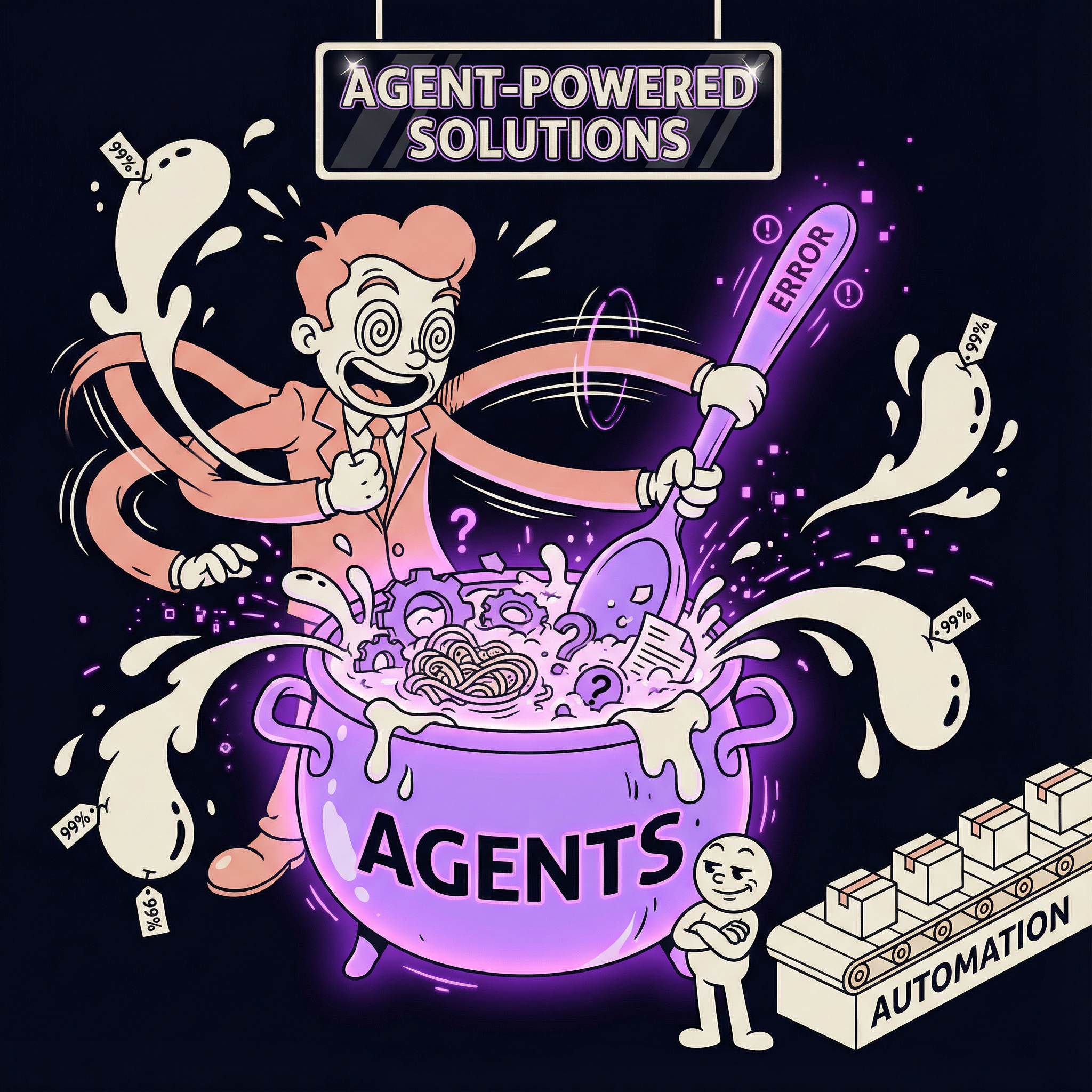
If someone who's built the world's most advanced AI agent platform struggles with misuse, what chance does a budget-setting executive have?
I just got off a call with Philip Alm. He's the co-founder and CEO of Incredible.one, a Swedish AI company that went straight to #1 on Product Hunt with what might be the most advanced AI agent platform I've ever seen. Winner of Sweden's largest innovation award. Backed by serious investors. The real deal.
And yet, even with early access to his cutting-edge platform, I found myself sitting there asking: What would I actually use agents for?
This isn't false modesty. I bring eight years of AI experience. I've built agentic systems, automated workflows, consulted on AI strategy for companies of all sizes. If anyone should know what to use agents for, it's me.
But I paused. And that pause matters.
The 99% Problem
Here's what Philip told me that stuck: "Ninety-nine percent of the use cases people build aren't actually agent use cases."
Read that again.
The builder of one of the world's most advanced agent platforms, the person with the clearest view of how people actually use his technology, says almost everyone is using it wrong. Sure, you can solve these problems with an agent. But should you? It's like using a sledgehammer for a thumbtack.
Get me right. This isn't a criticism of his users. It's an observation about where we are in this adoption curve. People hear "agents" and think it's the future. So they try to force everything into that box.
The result? Overcomplicated solutions to simple problems.
The research backs this up. Gartner predicts that over 40% of agentic AI projects will be canceled by 2027—due to escalating costs, unclear business value, or inadequate risk controls. McKinsey's latest findings are even more sobering: some companies are already "retrenching"—rehiring people where agents have failed. Their conclusion? "Agents aren't always the answer—in some contexts traditional automation is still the smarter choice."
Meanwhile, vendors are making things worse. Gartner calls it "agent washing"—the rebranding of chatbots and RPA tools as "agents" without any real agentic capabilities. Of the thousands of vendors claiming to sell agents, Gartner estimates only about 130 are legitimate.
What Most People Miss: The Distinction
Let me provide some clarity around my understanding of agents, agentic systems and automations.
An agent, by classical AI definitions, possesses four core characteristics: autonomy (operating independently without constant human oversight), perception (gathering information from their environment), rational decision-making (analyzing options and choosing actions that maximize goal achievement), and goal-directed behavior (proactively pursuing objectives, not just reacting to prompts). Advanced agents add learning and adaptability—continuously improving through experience. The highest-tier agents even set their own goals and create tools as needed.
In practice, when we talk about true agents, we're talking about specialized roles, sub-agents, supervisors, hierarchy. We're talking about systems that decide themselves whether to go route A or B—not based on business logic I implemented, but based on judgment. We're talking about actually replacing parts of people's work.
An agentic system follows decision trees I built. It looks autonomous, but I defined the paths. It's still automation at its core.
Automation is deterministic. Same input, same output. Every time.
(Side note: If you've encountered "agents" in Microsoft Copilot, you've met something that covers the ground between true agents and agentic systems—which makes this even more confusing. For many, Copilot will be their first touchpoint with something called an "agent." No wonder the lines are blurry.)
Most "agent use cases" I see are really agentic systems. Many agentic systems would work better as simple automation. And some automation could be a spreadsheet.
The tool should match the problem. But we've got the shiny new hammer, so everything looks like a nail.
The Hype We Skipped
Here's something we don't talk about enough: we completely skipped the automation hype.
I was working in automation when that wave should have peaked. But it never did. It was too complicated for management to understand. The speed to value was too slow. So we jumped past it.
All those consultancy waves—big data, cloud, digitization—they all had their moment. Automation got skipped. Now we're jumping to AI and agents without the groundwork:
- When do you need exact, deterministic results?
- When do you need less exact but more human, non-deterministic results?
- When is AI even needed at all?
Without answers to these questions, companies are making million-dollar decisions based on vibes and vendor pitches.
The Magnifier Problem
AI is a magnifier. It makes everything faster, louder, bigger.
Feed it chaos, and it amplifies chaos. Feed it broken processes, and it breaks them faster. Feed it messy data, and it produces messy outputs at scale.
Agents stir even faster.
Before asking for agents, you need to understand what you're actually trying to solve. You need the groundwork. Most companies don't have it. They're trying to run before they can walk.
Philip's experience confirms what I see in my day-to-day work: the technology isn't the bottleneck. Understanding is.
The Management Upskilling Gap
If I bring eight years of AI experience and still have to pause at "what would I use agents for?"—how should decision-makers investing millions know? How should managers allocating resources know? How should workers wondering about their futures know?
They can't. Not without upskilling first.
McKinsey's State of AI 2025 report puts numbers to this gap: 88% of organizations now report using AI, but only 6% are seeing real financial impact. Just 1% believe their AI adoption has reached maturity. Everyone's doing something. Almost no one's doing it well.
The earlier leadership teams build this understanding, the further ahead they are. But most are still struggling to differentiate between automation and AI. Between agentic and truly autonomous. Between what sounds impressive in a demo and what actually creates value.
Philip said it well in an interview: the key is "the ability to distinguish between technology demonstrations and genuine value."
That's the gap. And it's widening every day.
What This Means for You
If you're planning AI investments for the year ahead, start with these questions:
Before reaching for agents, ask:
- What problem am I actually solving?
- Does this need judgment, or does it need consistency?
- Have I automated the basics first?
- Would a simpler solution work?
Before approving the budget, ask:
- Can my team distinguish automation from AI from agents?
- Do we have the groundwork (clean processes, good data) to benefit from AI?
- Are we solving a real problem or chasing a demo?
The unsexy truth: most companies need automation, not agents. They need to fix their processes before they amplify them. They need management that understands the distinction before they invest in the technology.
The Question That Matters
I walked away from my conversation with Philip with a deeper appreciation for where we actually are. Not where the hype says we are. Where we actually are.
The agent era is coming. Philip and his team are building the infrastructure for it. But we're not there yet. Not for most use cases. Not for most companies.
The question isn't "what agent should I build?" The question is: "do I even need one?"
For ninety-nine percent of you reading this, the honest answer is probably no. Not yet.
Start with the groundwork. Understand the distinctions. Build the basics. Then, when you're actually ready, the agents will be waiting.
References
If you're a leader trying to figure out where AI actually fits in your business, my AI Adoption Sprint takes you from confused to confident in one week. We do the groundwork together—so you know exactly what you need before you invest in what you don't.
And if you'd rather have someone build the right solution for you (often automation, not agents), reach out about our Done-for-You automation service. We'll build what you actually need in 1-2 weeks.